
UConn Ward Release Paths
The UConn Health Medical-Surgical Ward is not a separate public jail and does not publish a released-inmate list. CT DOC places the ward under Hartford Correctional Center and describes it as a level 5, co-ed inpatient and outpatient program at the University of Connecticut Health Center in Farmington. A person treated there remains in the Connecticut Department of Correction custody path.
Physical departure from the ward can mean return to Hartford Correctional Center, transfer to another CT DOC location, legal release from correctional custody, parole or community release, or transfer to another agency. A hospital discharge in the medical sense is not enough to prove a correctional release. The controlling court order, DOC status, and receiving location must be checked. This distinction is vital when a family knows treatment ended but does not know whether custody ended.
| Ward departure | Custody result | Confirmation route |
|---|---|---|
| Return to correctional center | State custody continues | CT DOC facility status |
| Move to another DOC unit | State custody continues | CT DOC inmate record |
| Court or sentence release | Physical DOC custody may end | DOC status and court record |
| Parole or community status | Supervision continues | DOC, BOPP, and VINE |
Confirm UConn Ward Release
Begin with the CT DOC Inmate Information Search. Use a DOC inmate number when known. Otherwise, search by last name and compare first name and birth information. The listed location may be Hartford Correctional Center, the ward, or another CT DOC site, depending on how the agency displays the current assignment. The statewide record, not a general medical-patient system, is the proper custody source.
- Search the CT DOC record and note the status, facility, and any release-related field displayed.
- Check Connecticut VINE for covered custody changes and notifications tied to the inmate ID.
- Review the Connecticut court case for bond, sentence, disposition, or the order authorizing release.
- Call CT DOC Public Information if the public result does not resolve the person's correctional status.
- Use parole or community-service sources only if release into supervision is shown.
The CT DOC database is updated daily, yet the agency warns that details may change quickly. A missing name does not by itself prove release. It can also reflect an excluded record, an identifier problem, or movement to a different system.
UConn Ward Release Records
The ward's public page is the source for its correctional role. Person-specific release questions route through CT DOC, Hartford Correctional Center, the court, or the agency that supervises the person afterward. Medical information has separate privacy limits and should not be confused with the public correctional status fields. Ask for the correctional release, transfer, or facility record that is relevant to the custody event.
177 Weston Street
Hartford, CT 06120
Phone: (959) 200-3000
Fax: (959) 200-3008
24 Wolcott Hill Road
Wethersfield, CT 06109
Phone: (860) 692-7780
Monday through Friday, 8:00 a.m. to 4:30 p.m.
Supply the full name and DOC inmate number when available. State the record sought, such as a facility assignment, transfer, release date, or custody-status clarification. A broad request for medical records is not the same request and may not be releasable. The court case should be checked separately for the legal order or disposition behind release.
UConn Ward Custody Details
The official UConn Ward Unit page identifies a secure state correctional medical program rather than an open hospital ward or municipal lockup. CT DOC describes both inpatient and outpatient work within its level 5 program. Hartford Correctional Center oversees the unit. Those details set the proper records boundary: DOC owns the correctional custody status, while the court owns the legal case.
The successful source capture below shows the CT DOC UConn Ward Unit source.
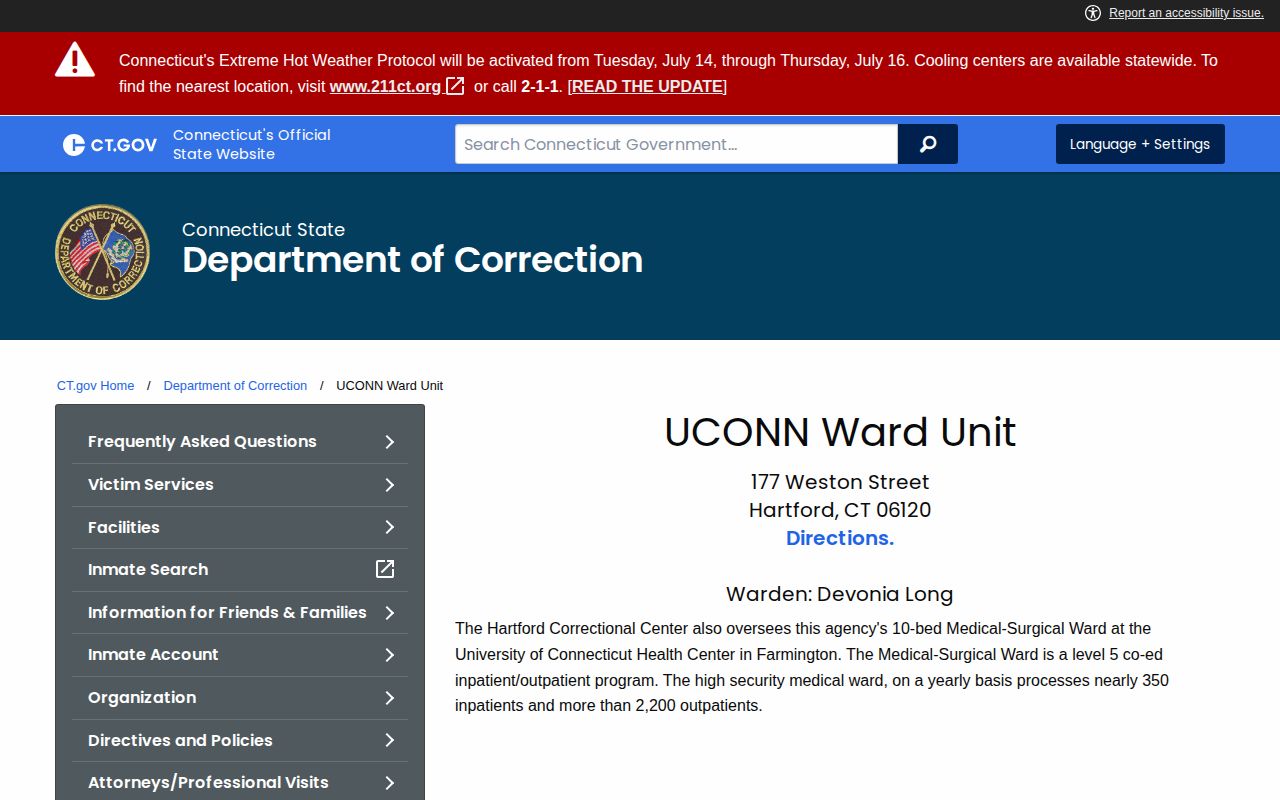
Use that source to identify the unit, then use inmate information, court records, and official contacts to resolve a named person's release.
UConn Ward Release or Transfer
A transfer is often the key source of confusion. The person may no longer be at the medical ward but may still appear at Hartford Correctional Center or another CT DOC facility. That is continued confinement. By contrast, release on bond, sentence completion, court discharge, parole, or another community authority changes the person's legal status even if supervision follows.
Read the status and facility fields together. Then compare them with the court record. VINE can add notice of a covered custody change, but it is not the final legal release record. For a person connected to a West Hartford arrest, West Hartford Police Records may hold the starting arrest and case report, but it cannot certify a later state correctional discharge.
- Medical discharge
- The end of treatment at a medical setting.
- Correctional release
- The end or change of physical custody under legal authority.
- Transfer
- Movement to another unit or agency while custody continues.
- Community supervision
- Parole or another controlled status outside the institution.
The West Hartford County custody search explains how to move from the municipal arrest record to CT DOC, court, and notification sources without treating one system as a complete history.
UConn Ward Release and ICE
ICE custody remains a separate system even when the state correctional event began at Hartford Correctional Center or included treatment at UConn Health. CT DOC says people held for ICE are not included in its public inmate database. A person may therefore leave the ward and state correctional custody but move under immigration authority. That sequence is not a release into the community.
If records identify an immigration transfer, check the ICE Online Detainee Locator System. It covers current ICE custody and CBP custody longer than 48 hours. Confirm the state side through CT DOC and the court as well. The ICE locator does not provide the Connecticut court disposition, while the DOC record does not determine the immigration case.
Note: A medical placement, state release, and immigration transfer may occur in sequence, so each event needs confirmation from its own custodian.
UConn Ward Record Limits
No public UConn ward release feed, hospital roster, or independent booking list exists in the research. The correct public sources are narrower. CT DOC inmate information gives a changing custody view. The ward page explains the unit. Court records supply the legal case and disposition. VINE supplies covered alerts. Agency records can resolve details not shown online.
Do not infer the reason for treatment or seek medical facts merely to answer a release question. The custody issue can usually be framed through the correctional status, transfer record, court order, release date, and supervision result. This keeps the inquiry tied to the official event and avoids confusing health care with legal custody.
Trace UConn Ward Custody
A clear search follows the legal custody sequence. Start with the West Hartford Police record when the arrest began locally. That report can identify the arrest, case number, and any remand. The Connecticut court record can then show the order that placed or kept the person in custody. Once CT DOC takes control, its statewide inmate information and facility records become the main sources for location, status, and release-related fields.
The UConn ward appears within that DOC sequence. It is a secure medical assignment overseen by Hartford Correctional Center, not a fresh booking by a hospital. The person may arrive from Hartford or another DOC site, receive inpatient or outpatient care, and then return to a correctional unit. None of those medical movements alone proves a legal discharge. Check the displayed correctional facility after the ward stay before searching for a release record.
If the DOC record shows or suggests physical release, compare the event with the court order. Bond, sentence completion, court discharge, parole, and community release have different legal effects. BOPP or Parole and Community Services becomes relevant only when supervision follows. Connecticut VINE can add a notice for a covered custody change, but the notice should be paired with the source that authorized the change.
The CT DOC Public Information Office is useful when a public result does not show whether a move was a ward transfer or a release. Ask about correctional status rather than medical treatment. A focused question can identify the listed facility, whether DOC physical custody continues, and which office holds an existing release or transfer record. This preserves the line between protected health information and correctional custody facts.
UConn Ward Release Fields
Useful correctional fields include the person's name and DOC number, listed facility, status, release date when displayed, projected or maximum date when available, and any supervision indication. Court fields add the case number, charge, bond or sentence, disposition, and order date. No one field supplies the full story. Match identifiers across the records and note when each source was checked because CT DOC says its public data can change quickly.
For a past event, request an existing facility, transfer, or release record with a date range. Do not ask the ward to create a narrative that combines medical care, court action, and correctional release. Those facts belong to different custodians. A precise record inventory produces a cleaner answer and reduces the chance that the end of treatment will be mislabeled as the end of custody.
Public Record Search
Sponsored Results